

Astigmatism in Austin, TX
Astigmatism is one of the most common vision conditions we see at Freedom Eye Care in Austin, TX, and one of the most frequently misunderstood. Despite the name sounding complex, astigmatism is a refractive error — a variation in the shape of the cornea or lens that affects how the eye focuses light. The good news is that astigmatism is highly treatable, and most patients achieve excellent vision with the right glasses, contact lenses, or combination of corrections. If you experience blurry or distorted vision at any distance, eye strain, or frequent headaches, astigmatism may be the cause.
Book OnlineWhat Is Astigmatism?
A normal cornea is smooth and evenly curved in all directions — shaped like a perfectly round ball. In astigmatism, the cornea (or less commonly, the lens inside the eye) is shaped more like a football — with two different curves at perpendicular angles. This uneven curvature means that light entering the eye bends differently in different meridians, creating two focal points instead of one. The result is blurred or distorted vision at all distances, not just at far or near, which distinguishes astigmatism from myopia (nearsightedness) or hyperopia (farsightedness) — though astigmatism is very commonly present alongside either of those conditions.
There are two primary types of astigmatism. Corneal astigmatism involves an irregularity in the shape of the cornea itself and is the most common form. Lenticular astigmatism involves a variation in the curvature of the crystalline lens inside the eye. Most cases of astigmatism are regular — meaning the two principal meridians are perpendicular to each other and can be corrected with standard lenses — but irregular astigmatism, sometimes caused by corneal conditions like keratoconus or corneal scarring, may require specialty lens solutions.
Symptoms of Astigmatism
Astigmatism can range from very mild — causing barely noticeable symptoms — to more significant, affecting daily activities and quality of life. Common symptoms include:
- Blurry or distorted vision at all distances
- Difficulty reading, particularly with small or closely spaced text
- Eye strain, especially after prolonged near work or screen time
- Headaches, particularly at the front of the head or around the eyes
- Squinting to try to see more clearly
- Difficulty with night vision, including halos or streaking around lights
- Tilting the head to one side to try to improve focus
Children with astigmatism often cannot articulate that their vision is blurry — they simply accept it as normal. This makes routine pediatric eye exams at Freedom Eye Care essential for early detection, as untreated astigmatism in children can contribute to amblyopia (lazy eye) if not corrected promptly.
How Astigmatism Is Corrected
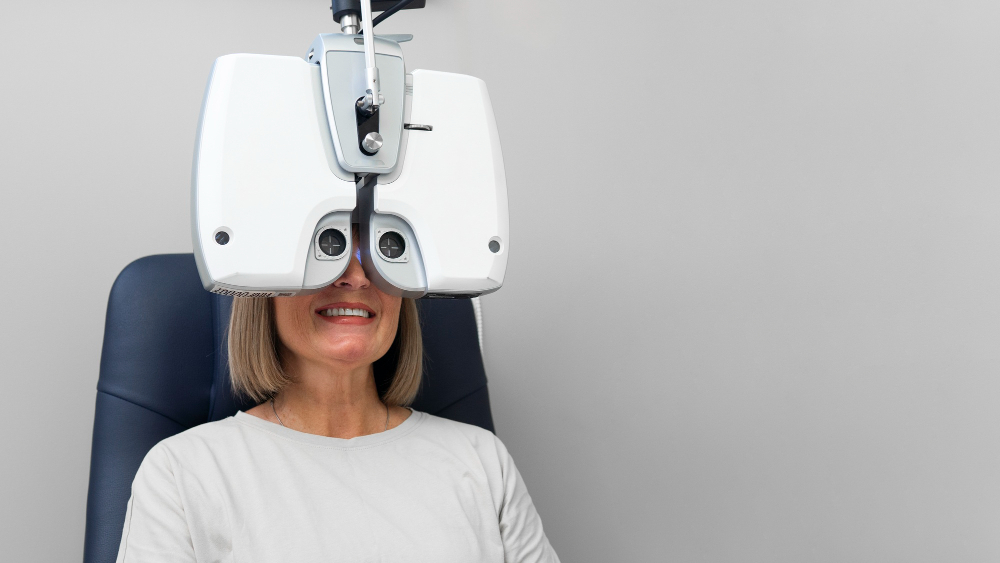
Astigmatism is diagnosed during a comprehensive eye exam at Freedom Eye Care using refraction testing and corneal topography, which maps the shape and curvature of the corneal surface in precise detail. Once the type and degree of astigmatism are established, correction options include:
- Eyeglass Lenses: Cylindrical lens correction is incorporated directly into your eyeglass prescription to compensate for the irregular corneal or lens curvature. This is the simplest and most commonly used correction for astigmatism.
- Toric Contact Lenses: Specially designed contact lenses with different powers in different meridians that stay oriented correctly on the eye to maintain precise correction. Toric lenses are available in daily, bi-weekly, and monthly replacement schedules — learn more about our contact lens fitting services.
- Rigid Gas-Permeable (RGP) Lenses: For patients with higher or irregular astigmatism, RGP lenses create a smooth, uniform refracting surface over the irregular cornea, often providing sharper vision than soft lenses can achieve.
- Scleral Lenses: Vaulting entirely over the corneal surface and resting on the sclera, scleral lenses are an excellent option for patients with significant irregular astigmatism or corneal conditions where standard lenses are insufficient.
Call Freedom Eye Care at (512) 916-4600 or book your astigmatism evaluation online. Our team will determine the exact nature of your astigmatism and find the correction that gives you the sharpest, most comfortable vision possible.
Frequently Asked Questions About Astigmatism in Austin, TX
Is astigmatism serious?
Astigmatism is a very common refractive error and is not considered a disease or a sign of eye damage. For most patients, it is easily managed with glasses or contact lenses. However, uncorrected astigmatism — particularly in children — can lead to amblyopia if the brain begins suppressing input from the affected eye. In adults, uncorrected astigmatism causes unnecessary eye strain, headaches, and reduced quality of vision that affect daily activities. Prompt correction at Freedom Eye Care is simple and effective.
Can astigmatism get worse over time?
Astigmatism can change over time, particularly during childhood and adolescence as the eyes develop. In adults, astigmatism is generally more stable, though small changes are common and are detected during your regular eye exams at Freedom Eye Care. Some corneal conditions — like keratoconus — can cause progressive, irregular astigmatism that requires more specialized management. Regular monitoring ensures any changes are caught and corrected promptly.
Can I wear regular (spherical) contact lenses if I have astigmatism?
It depends on the degree of astigmatism. Mild astigmatism (typically under 0.75 diopters) can sometimes be adequately corrected with standard spherical contact lenses. More significant astigmatism requires toric contact lenses that compensate for the cylindrical component of the correction. Our optometrist at Freedom Eye Care will determine the best lens option during your contact lens fitting, and trial lenses are always evaluated before any prescription is finalized.
Does astigmatism cause headaches?
Yes. Uncorrected or inadequately corrected astigmatism is a common cause of eye strain and tension headaches, particularly after extended reading, screen use, or close work. The eye muscles work harder to compensate for the refractive error and try to bring blurry images into focus, leading to fatigue and discomfort. Updating your prescription at Freedom Eye Care typically resolves these symptoms quickly.
Is astigmatism hereditary?
There is a genetic component to astigmatism — it often runs in families. Children of parents with astigmatism have a higher likelihood of developing it themselves. However, astigmatism can also develop in people with no family history. Because children may not recognize that their vision is blurry, routine pediatric exams at Freedom Eye Care are the most reliable way to catch astigmatism early, particularly before it affects learning and development.
Can astigmatism be corrected with LASIK?
Yes, laser refractive surgery including LASIK and PRK can correct most forms of regular astigmatism in adults with stable prescriptions. However, Freedom Eye Care does not perform refractive surgery — if you are interested in exploring surgical correction, we can provide a thorough pre-surgical evaluation and a referral to a trusted refractive surgery specialist in the Austin area. We continue to provide your ongoing eye health care before and after any surgical procedure.