
Pediatric Eye Care in Austin, TX
A child’s ability to learn, develop, and thrive is deeply connected to how well they see. Approximately 80% of what children learn in school is presented visually — which means an undetected vision problem can quietly hold a child back in ways that may look like attention difficulties, learning challenges, or behavioral issues. At Freedom Eye Care in Austin, TX, we provide comprehensive pediatric eye exams in a warm, child-friendly environment designed to put kids at ease. From infants to teenagers, our team is experienced in evaluating every stage of visual development and addressing issues early, before they affect your child’s potential.
Book OnlineWhy Pediatric Eye Exams Are Essential
Many parents assume their child’s vision is fine if they pass a school vision screening, but school screenings are limited — they only check distance vision using a basic eye chart. They cannot detect conditions like amblyopia (lazy eye), strabismus (eye misalignment), convergence insufficiency, color vision deficiency, or binocular vision disorders that can significantly impact learning and development. A comprehensive pediatric eye exam at Freedom Eye Care evaluates all aspects of your child’s visual system, including how the eyes focus, how they work together, and how the brain processes visual information.
Vision problems in children often go unnoticed because children assume their blurry or uncomfortable vision is normal — it is all they have ever known. Without a proper eye exam, conditions like amblyopia (lazy eye) must be treated before a certain age or the affected eye may never develop full visual potential, even with glasses. Early intervention is the key to the best outcomes. The American Optometric Association recommends that children receive their first comprehensive eye exam at 6–12 months of age, again at age 3, and again before starting school — then annually throughout their school years.
What to Expect at Your Child’s Eye Exam
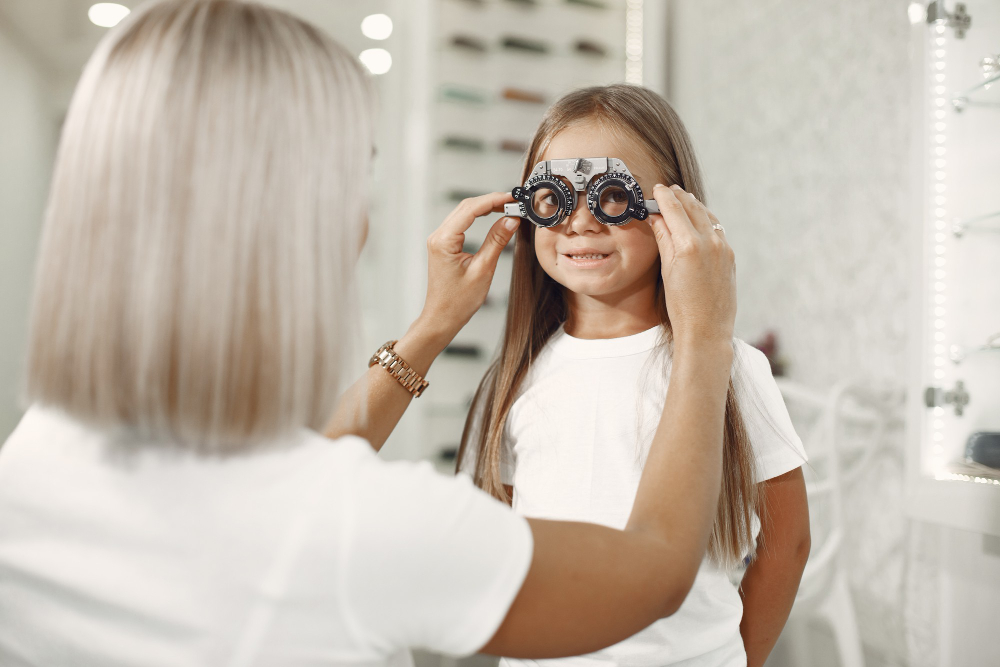
Pediatric eye exams at Freedom Eye Care are thoughtfully adapted for children of every age. We understand that kids may feel nervous about visiting the eye doctor, and our team creates a relaxed, friendly atmosphere to make the experience positive and stress-free. For infants and toddlers, we use specialized techniques that do not require verbal responses — we evaluate how the eyes move, focus, and align using visual targets and reflexive responses. For older children, exams are more interactive and include many of the same elements as an adult comprehensive exam, adapted to be engaging and easy to follow.
Your child’s exam may include tests for:
- Visual acuity (how clearly they see at distance and near)
- Refractive errors such as nearsightedness, farsightedness, and astigmatism
- Eye alignment and eye teaming (binocular vision)
- Amblyopia (lazy eye) detection and monitoring
- Color vision testing
- Eye focusing ability and accommodation
- Eye health evaluation including the retina, optic nerve, and cornea
- Eye pressure screening for glaucoma risk
After your child’s exam, we will walk you through our findings in detail and explain any recommendations clearly. If your child needs glasses, we offer guidance on frame selection and lens options to suit active kids. We also coordinate with teachers and school counselors when vision issues are impacting academic performance. For children with diabetes, we offer diabetic eye exams to monitor for retinal changes that can develop even in young patients.
Common Pediatric Vision Conditions We Treat
At Freedom Eye Care, we diagnose and manage a wide range of pediatric eye conditions, including:
- Myopia (Nearsightedness): The most rapidly growing vision problem in children worldwide. Children with myopia see close objects clearly but struggle to see the board at school or objects at a distance. Myopia often progresses quickly during school-age years, and we offer myopia management strategies to slow its progression and reduce long-term eye health risks.
- Hyperopia (Farsightedness): Children with significant farsightedness may struggle with near tasks like reading, experience eye strain, or develop crossed eyes as a result of over-focusing.
- Astigmatism: An irregular corneal or lens shape that causes blurry vision at all distances. Astigmatism is very common in children and is easily corrected with glasses or contact lenses.
- Amblyopia (Lazy Eye): Reduced vision in one eye that develops when the brain favors the other eye. Early treatment — typically with glasses, patching, or vision therapy — is essential for full visual recovery.
- Strabismus (Eye Turn): Misalignment of the eyes, where one or both eyes turn in, out, up, or down. Strabismus can lead to amblyopia if untreated and may require glasses, prism lenses, vision therapy, or referral for surgical correction.
If you have any concerns about your child’s vision or eye health, do not wait for the next school screening. Call Freedom Eye Care at (512) 916-4600 or schedule your child’s eye exam online today.
Frequently Asked Questions About Pediatric Eye Care in Austin, TX
When should my child have their first eye exam?
The American Optometric Association recommends that children receive their first comprehensive eye exam between 6 and 12 months of age. The next exam should be around age 3, and again before starting kindergarten (age 5–6). After that, annual eye exams are recommended throughout the school years. Don’t wait for a failed vision screening — a school chart test is not a substitute for a comprehensive exam at Freedom Eye Care.
My child passed their school vision screening. Do they still need an eye exam?
Yes. School vision screenings only test distance vision using a simple eye chart. They cannot detect conditions like amblyopia, strabismus, convergence insufficiency, eye teaming problems, or focusing disorders — all of which can significantly affect how a child reads, learns, and concentrates. A comprehensive pediatric eye exam at Freedom Eye Care evaluates the full visual system and catches problems that screenings routinely miss.
What are signs that my child may have a vision problem?
Signs that your child may be struggling with their vision include squinting, sitting too close to the TV or screen, frequent eye rubbing, tilting their head to look at things, covering one eye, complaints of headaches or tired eyes, avoiding reading or near tasks, losing their place while reading, or performing below their potential at school. If you notice any of these signs, schedule an exam at Freedom Eye Care as soon as possible.
At what age can children start wearing contact lenses?
There is no set age requirement for contact lens wear in children — readiness depends on maturity, responsibility, and hygiene habits rather than age alone. Many children are ready to try contacts between ages 11 and 14. At Freedom Eye Care, we assess each child individually and involve both the child and parents in the decision. We provide thorough training on safe lens insertion, removal, and care to ensure a smooth transition.
What is myopia management and does my child need it?
Myopia management refers to treatments designed to slow the progression of nearsightedness in children, rather than simply correcting it with glasses. This matters because high levels of myopia significantly increase the lifetime risk of serious eye conditions like retinal detachment, glaucoma, and macular degeneration. Options may include specialty contact lenses (orthokeratology or soft myopia control lenses), atropine eye drops, or updated glasses designs. Freedom Eye Care evaluates children with progressive myopia and recommends the most appropriate management approach.
Can vision problems cause learning difficulties in children?
Absolutely. Many children diagnosed with attention difficulties, reading challenges, or learning disabilities actually have undetected vision problems that make it difficult to sustain focus on near tasks, process text accurately, or use both eyes together efficiently. While a vision problem does not cause learning disabilities, it can significantly compound them or mimic their symptoms. A thorough eye exam at Freedom Eye Care rules out visual causes of academic struggles and ensures your child has the best possible foundation for learning.
Does Freedom Eye Care see children with special needs?
Yes. Freedom Eye Care welcomes children with special needs, developmental delays, and other unique circumstances. Our team is patient and experienced in adapting exam techniques to children who may have difficulty with standard testing methods. We communicate directly with parents and caregivers throughout the process and take as much time as needed to ensure your child receives a thorough, comfortable evaluation. Please call us at (512) 916-4600 before your child’s appointment if there is anything we can do to prepare for their specific needs.