

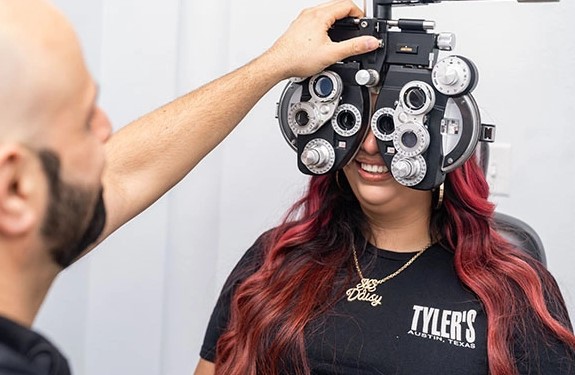
Eye Exam in Austin, TX
Scheduling a routine eye exam is one of the most important things you can do for your long-term health — and it is also one of the most commonly overlooked. At Freedom Eye Care in Austin, TX, we believe that clear vision and healthy eyes should never be left to chance. Our comprehensive eye exams are designed to detect problems early, keep your prescription accurate, and give you a thorough understanding of your eye health at every stage of life. Whether you are coming in for the first time or returning for your annual visit, our team brings the same level of attention and care to every appointment.
Book OnlineWhy Routine Eye Exams Are Essential
Many of the most serious eye conditions — including glaucoma, macular degeneration, and diabetic retinopathy — develop without pain, without obvious symptoms, and without any noticeable change in your vision until significant and often irreversible damage has already occurred. A routine eye exam is the only reliable way to detect these conditions in their early, most treatable stages. Beyond disease screening, regular exams also ensure your vision prescription stays current, preventing the eye strain, headaches, and difficulty focusing that come with wearing an outdated prescription.
Eye exams are valuable at every age. Children depend on clear vision for learning and development — vision problems that go undetected can affect reading, attention, and academic performance. Adults benefit from monitoring refractive changes and screening for age-related eye conditions. And for older adults and patients with systemic conditions like diabetes or high blood pressure, annual exams are a critical safeguard against complications. The team at Freedom Eye Care provides exams tailored to each patient’s age, health history, and risk factors, including dedicated pediatric eye care and diabetic eye exams.
What Happens During Your Eye Exam at Freedom Eye Care
Your eye exam at Freedom Eye Care follows a thorough, organized process designed to leave nothing unchecked. Your visit begins with a conversation — we ask about your vision history, any symptoms you have noticed, your daily activities, and your general health. This background helps us focus the exam on what is most relevant to your eyes. From there, your exam typically includes:
- Visual Acuity Testing: Measuring how clearly you see at distance and near using a standardized eye chart to establish your baseline and compare against previous visits.
- Refraction: Determining the lens prescription that gives you the clearest, most comfortable vision — this is the process that produces your eyeglass prescription or contact lens prescription.
- Binocular Vision Assessment: Evaluating how well your eyes work together — including eye teaming, depth perception, and eye movement accuracy.
- Slit-Lamp Examination: Detailed inspection of the front structures of the eye including the cornea, iris, and lens using a high-powered microscope.
- Eye Pressure Measurement (Tonometry): Screening for elevated intraocular pressure, a primary risk factor for glaucoma.
- Retinal Evaluation: Examination of the back of the eye — retina, optic nerve, and blood vessels — using digital imaging and, when indicated, dilation or OCT scanning.
- Dry Eye Screening: Evaluation of your tear film quality and quantity, which informs our dry eye treatment recommendations if needed.
Following your exam, our optometrist will review all findings with you, explain any recommendations, and answer every question you have before you leave.
Advanced Technology That Makes Every Exam More Accurate
At Freedom Eye Care, we invest in modern diagnostic tools that allow us to see your eyes with a level of detail that was not possible even a decade ago. Digital retinal photography captures high-resolution images of the back of your eye — images that can be compared at future visits to track subtle changes over time. Optical coherence tomography (OCT) creates precise cross-sectional images of your retinal layers, making it possible to identify early signs of macular degeneration, diabetic retinopathy, and glaucoma before they affect your vision. Visual field testing maps your full peripheral field to detect areas of loss that you might not notice in everyday life. Together, these technologies make your exam more thorough, your diagnoses more accurate, and your long-term outcomes meaningfully better. Call Freedom Eye Care at (512) 916-4600 or book your eye exam online today.
Frequently Asked Questions About Eye Exams in Austin, TX
How often should I get an eye exam?
The American Optometric Association recommends a comprehensive eye exam every two years for healthy adults with no known risk factors. Annual exams are recommended for children throughout school, adults over 60, patients with diabetes, those with a personal or family history of eye disease, and anyone who wears contact lenses. Freedom Eye Care will recommend the right schedule for your specific health profile at your appointment.
What should I expect if it’s my first time at Freedom Eye Care?
Your first visit to Freedom Eye Care will begin with completing your new patient paperwork — you can save time by filling out our forms online before you arrive. Our team will review your vision and health history, then our optometrist will perform a thorough examination tailored to your needs. You can expect a welcoming, organized experience without long waits. We encourage you to bring your current glasses or contacts, your insurance card, and a list of any medications you take.
Can eye exams detect diabetes or other systemic conditions?
Yes. The eyes provide a unique and direct window into the body’s vascular and neurological health. During a comprehensive eye exam, our optometrist may identify signs of diabetes, high blood pressure, high cholesterol, thyroid disease, and other systemic conditions through changes in the retinal blood vessels and surrounding structures. Many patients have been referred to their primary care physician following eye exam findings — making regular eye exams a valuable piece of overall preventive health care.
I wear glasses already — do I still need a full eye exam?
Absolutely. Wearing glasses or contacts does not eliminate the need for comprehensive eye exams — in fact, it adds to it. Your prescription can change over time, and an outdated prescription causes eye strain and reduces your quality of vision. More importantly, the health screening components of a comprehensive exam — glaucoma screening, retinal evaluation, disease detection — are just as essential for glasses wearers as for anyone else, regardless of how well your current prescription seems to be working.
What is the 20-20-20 rule and does Freedom Eye Care recommend it?
The 20-20-20 rule is a simple strategy to reduce digital eye strain: every 20 minutes of screen time, look at something at least 20 feet away for at least 20 seconds. This gives your eye-focusing muscles a brief rest and encourages blinking, which helps maintain a healthy tear film. Freedom Eye Care recommends this practice for patients who spend long hours on screens, and pairs it with evaluation for dry eye and recommendations for appropriate lens options when needed.
Is an eye exam covered by vision insurance?
Freedom Eye Care accepts a range of vision and medical insurance plans. Comprehensive eye exams are typically covered by vision insurance; medical conditions detected or managed during an exam (such as diabetic retinopathy or glaucoma) may be billed through medical insurance. We encourage you to check our insurance page or call our office at (512) 916-4600 before your visit to confirm your coverage and any out-of-pocket costs.
What if my child refuses to cooperate during their eye exam?
This is very common, especially with young children, and our team at Freedom Eye Care is experienced in making exams as child-friendly as possible. We use age-appropriate testing techniques, take breaks when needed, and keep the environment calm and non-threatening. For very young children who cannot identify letters, we use picture charts, light reflexes, and other objective testing methods that do not require verbal responses. If your child is anxious, calling ahead so we can prepare for the visit often makes a big difference.